


Capama Blog
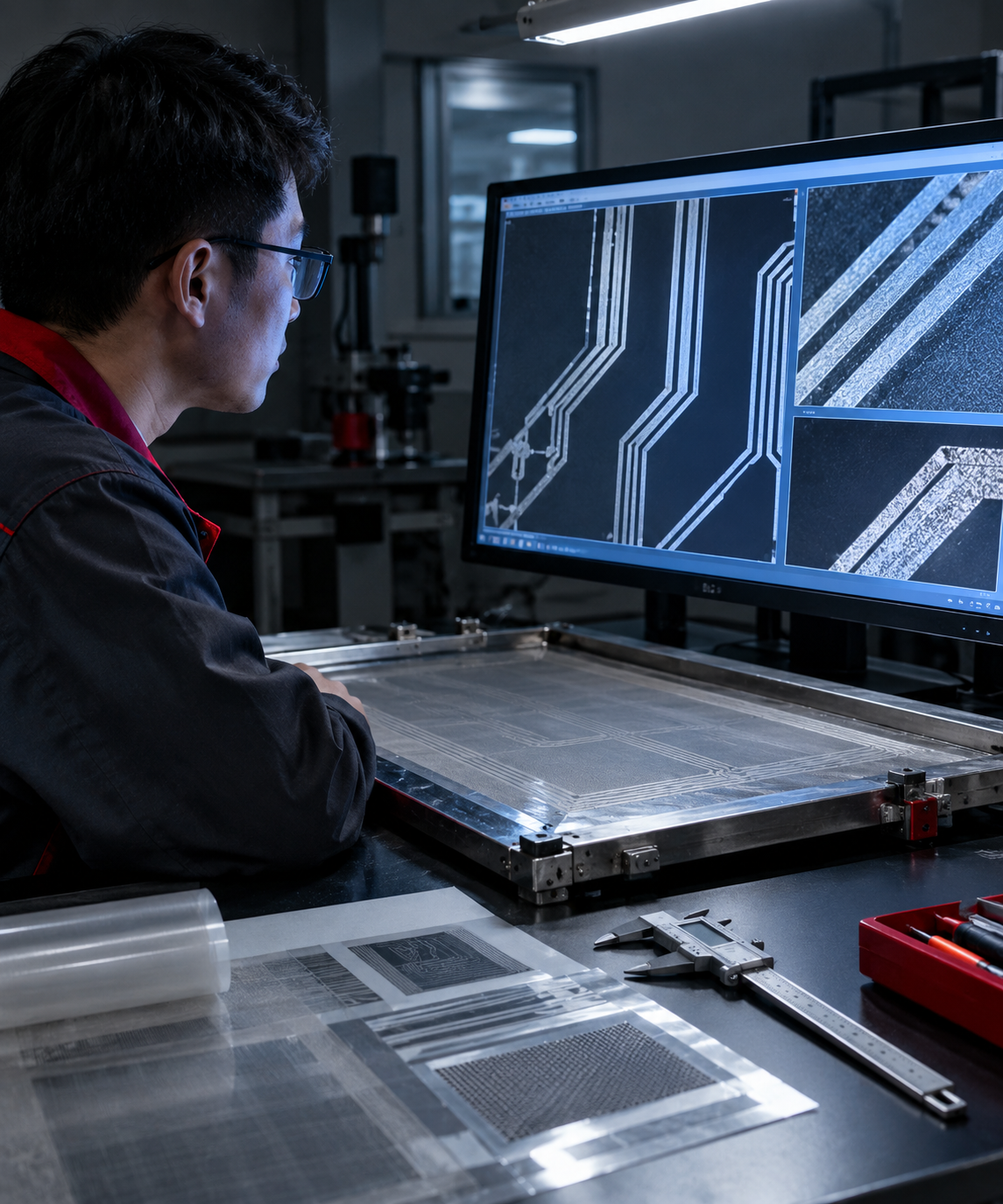
1. Flexible circuits and membrane switches: the most prepress-critical screen work there is
Flexible printed circuits, membrane switches and sensor electrodes are the least forgiving screen printing applications in terms of prepress.
The reasons are straightforward:
Expensive material — conductive silver paste uses a precious metal as its functional phase. A scrapped run costs material and machine time, so the cost of trial and error is far higher than with ordinary inks.
Fine lines — conductors often run in the fraction-of-a-millimetre range. Any drift in mesh count, tension or emulsion thickness eventually shows up as variation in sheet resistance.
Soft substrate — the base film is PET or polyimide (PI) tens of microns thick. A little too much web tension stretches it, and registration and dimensional stability become far more sensitive than on paper labels.
Acceptance already speaks the language of standards — CY/T 248-2021 sets sheet resistance, peel strength, high/low-temperature resistance and damp-heat resistance as formal clauses.
CY/T 248-2021, "Quality requirements for electronic devices using printed flexible transparent film", was issued by China's National Press and Publication Administration (published 2021-09-22, effective 2021-11-01) and is administered by the Screen Printing Subcommittee of the National Technical Committee on Printing Standardization (SAC/TC 170/SC 2). Membrane switch makers and packaging printers are among its drafting organisations — evidence that this acceptance framework has long since reached the membrane switch shop floor. A few of its hard numbers deserve a place on the prepress office wall:
| Item | Requirement (CY/T 248-2021) |
|---|---|
| Light transmittance | Not less than 75% |
| Protective layer peel strength | Not less than 10 N/cm |
| Transparent conductive layer sheet resistance | Not more than 500 Ω/□ |
| Low temperature | No delamination or cracking and compliant conductivity at service temperatures down to -25 °C |
| High temperature | No delamination or cracking and compliant conductivity at service temperatures up to +100 °C |
| Damp heat | After constant damp-heat testing at (40±2) °C and (85±3)% RH, no delamination or cracking, conductivity still compliant |
The conclusion is blunt: orders like these are won or lost in prepress, not in how fast the press runs. The sections below follow the prepress sequence.
2. Gate one: translating the design file into printable process numbers
A file that "opens fine" is not a file that is ready. Prepress has to turn the drawing into numbers the machine can execute.
◆ Line width sets mesh count and thread diameter. The central trade-off in fine-line printing is that a thicker thread cannot reproduce a finer line. Published mesh specification tables are a sound starting point — for example 325 mesh with 28 μm thread (41% open area), 400 mesh with 23 μm, 500 mesh with 19 μm and 640 mesh with 15 μm (mesh supplier published specifications). Work backwards from the finest line you must print to the thread you need, then confirm the emulsion and exposure capability that goes with it.
◆ Start mesh angle at 22.5°. Manufacturers' technical literature lists 22.5° as the standard bias angle, with 30° or 35° used to resolve moiré. The angle is not an aesthetic choice — it directly affects the jaggedness of a fine line's edge.
◆ Film stretch compensation must be measured, not borrowed. A dimension printed on paper is not the dimension you get on a PET or PI film. Film extends under tension, and the longer the web path and the higher the tension, the greater the cumulative stretch. The reliable route is to run calibration pieces on the actual substrate at the actual print length, measure the real elongation, and back-calculate the compensation value into the prepress process sheet. Never copy someone else's compensation factor.
◆ Give the layout a proper datum. For drawing conventions there is an existing national standard to reference: GB/T 5489-2018, "Printed circuit board draw" (current), provides a common language for board layout and graphic representation between the customer, the prepress team and the screen maker.
3. Gate two: screen making — tension, emulsion thickness, exposure
The screen is the only printing plate in screen printing, and the quality ceiling of the finished part is the quality ceiling of the screen.
| Prepress element | Process point and published reference values |
|---|---|
| Mesh tension | Too low: pattern distortion and registration drift. Too high: rapid mesh fatigue. Polyester commonly run at 12–14 N (manufacturer technical data; varies with mesh type and count) |
| Off-contact (snap-off) | Tied to the screen's inner dimension so the mesh rebounds cleanly after the squeegee passes. Roughly 1/300 of the screen inner dimension (screen supplier data); for precision fine-line work, 2–4 mm is a common working range (manufacturer experience values) |
| Emulsion thickness | Emulsion thickness determines ink deposit — its influence is greater than squeegee hardness or squeegee angle. Around the 10 μm order is common in industrial screen making (go thicker for heavy deposit, thinner for fine-line film work) |
| Squeegee pressure | Too little pressure gives uneven deposit and will not move high-viscosity paste. About 400–500 g per cm of squeegee length (screen supplier data) |
| Tensioning method | High-definition screens generally use combination tensioning for uniform tension; direct combination tensioning gives higher accuracy (screen supplier data) |
| Usable print area | Tension is less uniform near the frame, so keep artwork toward the centre — the high-quality printable area is roughly the inner 50% of the screen (screen supplier data) |
Two practices worth writing into the process sheet: record screen tension and re-measure it periodically (if sheet resistance differs between two runs of the same order, check screen tension before blaming the paste); and fix emulsion thickness first, then tune everything else (compensating for ink deposit with squeegee pressure or angle gives poor stability and poor reproducibility).
4. Gate three: silver paste and the curing window — this is where resistance and adhesion are decided
The most easily overlooked and genuinely most expensive prepress step is establishing the curing profile.
◆ Identify the paste class first. The non-ferrous metals industry standard YS/T 606, "Curable silver conductive paste", classifies silver pastes by use: low-temperature silver paste for membrane switches, fast-dry low-temperature paste for membrane switches, carbon-film potentiometer paste, and one- and two-component silver conductive adhesives. The revision draft gives this process window:
| Product type | Curing temperature °C | Curing time min |
|---|---|---|
| Low-temperature paste for membrane switches | 80–160 | 30–90 |
| Fast-dry low-temperature paste for membrane switches | 130–160 | 1–2 |
| Carbon-film potentiometer paste | 180–210 | 20–30 |
| One-component silver conductive adhesive | 120–200 | 15–60 |
| Two-component silver conductive adhesive | 25±5 / 80–150 | 720–1440 / 30–90 |
The same standard sets fineness (<10 μm) and viscosity (100–300 dPa·s) for membrane switch paste and defines a flex-resistance test using a standard line screen (200–300 mesh, line width 0.4 mm × length 100 mm) on 0.075 mm PET or PC film. In other words, "how much does resistance change after bending" is itself a standardised acceptance item.
◆ Align manufacturer data with the standard window. Published data for mainstream conductive silver pastes clusters in the same band: sheet resistance typically below 10 mΩ/sq at 25 μm dry film, oven curing at 80–150 °C for 15–30 minutes, compatibility with PET, PI, PC and paper, and screen printing at 40–120 lines/cm (published ink supplier parameters). Some suppliers also offer low-temperature series curing from 80 °C, and grades curing at 140 °C on polyimide (published paste supplier data).
◆ The curing window is bounded by the substrate's temperature limit. PET tolerates less heat than PI, so PET needs lower temperature for longer; PI allows higher temperature for less time. Under-cure leaves resistance high and adhesion poor; over-cure shrinks and distorts the film, and registration drifts with it. The prepress job is not to copy a curve but to measure one on your own substrate in your own oven, and then freeze it.
5. Gate four: printing parameters and registration control
On press, parameters are still not a matter of feel.
◆ Squeegee hardness by application. Manufacturer guidance is practical: heavy-deposit work favours a softer 60–70 durometer squeegee (thicker ink layer), thin-film work favours a harder squeegee around 80 (thinner, sharper deposit); soft for uneven substrates, hard for flat ones (ink maker technical literature).
◆ Squeegee angle, speed and pressure work as a set. Give adequate pressure (about 400–500 g/cm), hold the angle steady, and set a speed that controls tailing on fine lines.
◆ Registration relies on marks plus machine repeatability. Multi-colour continuous printing (for example conductive layer plus dielectric plus top coat) must be held by registration marks working with servo-driven print stations, not by an operator's eye.
◆ Write the environment into the job conditions. Solvent-based paste viscosity is sensitive to temperature and humidity. CY/T 248-2021 uses (40±2) °C and (85±3)% RH as its damp-heat test condition — a reminder of how much environmental control weighs in printed electronics work.
6. What makes membrane switches special in prepress
A membrane switch is a typical multi-layer printed structure. Under the structure diagram in CY/T 248-2021 it comprises a substrate (transparent flexible PET film), a conductive layer (flexible conductive ink film), an insulating layer (flexible insulating ink film) and a protective layer (transparent flexible plastic film), with the first three collectively called the functional layers.
That drives three prepress actions: settle the layer sequence and film thickness once (which mesh, which dry film thickness and which curing window applies to each layer must be fixed in prepress, not discovered during the run); test interlayer adhesion to the standard (CY/T 248-2021 requires protective layer peel strength of not less than 10 N/cm, tested with adhesive tape peel equipment under GB/T 2792-2014 — specimens 24 mm wide and 300 mm long, pulled apart at a uniform 300 mm/min, reading the average force); and leave margin for flexing (for flexible circuit qualification, IPC-6013, "Qualification and Performance Specification for Flexible Printed Boards", classifies flex boards by construction type and usage class and sets corresponding acceptance criteria; when designing line width and routing in prepress, treat the stress distribution in the bend area as part of the calculation).
7. The equipment side: roll-to-roll makes prepress values repeatable
Every gate above ultimately comes down to whether the same part can be produced repeatedly. That is precisely where roll-to-roll automatic screen printing earns its place. CAPAMA's Roll-to-Roll Automatic Screen Printers CPM 520SX / SXT, RR-320S and RR-520S:
cover 320 mm and 520 mm web widths, matching common flexible circuit impositions; use servo-driven print stations, so registration repeatability is a machine property and multi-colour continuous printing does not depend on manual positioning; run at up to 15 m/min, roughly 7,000 impressions per hour; handle material thickness from 0.02 mm to 15 mm, which includes PET and PI film rolls tens of microns thick; and print roll to roll with tension control, so film stretch can be held steady — which is the only way a prepress compensation value means anything.
For film panels needing a metallic finish or spot foil, the Screen Printing & Foil Stamping Machine TJ-350 brings screen printing and foil stamping into the same process chain. The whole logic reduces to one line: prepress sets the standard, production reproduces it.
8. Prepress checklist
★ Files: line width and spacing, imposition direction, registration marks, stretch compensation measured on the actual substrate
★ Screen: mesh count and thread diameter, re-measured tension, emulsion thickness, bias angle, usable print area
★ Paste: grade and batch, viscosity and fineness, measured curing profile split by substrate
★ First-off: registration deviation, sampled sheet resistance, adhesion (peel / cross-cut), resistance change after flexing
★ Retention and traceability: retain a sample per batch filed with the matching process sheet, so a customer-side anomaly can be traced back
Conclusion
In flexible circuit and membrane switch screen printing, the competition is not about who prints fastest but about who turns every prepress variable into a number that can be reproduced. Mesh count, tension, emulsion thickness, curing profile, compensation value — write these into the process sheet today, and tomorrow you can accept a customer's standard clauses with confidence. Replacing uncertain manual steps with a reproducible roll-to-roll process is the step that takes a screen printing shop from "we can do it" to "we can deliver it".
CAPAMA (Shanghai) Machinery Co., Ltd. · Roll-to-Roll Automatic Screen Printers CPM 520SX / SXT, RR-320S / RR-520S · Screen Printing & Foil Stamping Machine TJ-350
Website: www.capama.com · Technical consultation: +86 13681972820
References:
[1] CY/T 248-2021 "Quality requirements for electronic devices using printed flexible transparent film" · National Press and Publication Administration (China) · standard text (PDF)
[2] YS/T 606 "Curable silver conductive paste", revision draft (superseding YS/T 606-2006) · National Technical Committee on Non-Ferrous Metal Standardization · review draft text (draft; published version prevails)
[3] GB/T 5489-2018 "Printed circuit board draw" · National Standards Information Public Service Platform · standard page
[4] IPC-6013 "Qualification and Performance Specification for Flexible Printed Boards" · as cited in a published design guide by Flexible Circuit Technologies · design guide (PDF) (as cited in a vendor design guide)
[5] Printed electronics conductive ink parameters · VFP Ink Technologies · vfp-ink.com
[6] Screen printable silver paste product data · Dycotec Materials · dycotecmaterials.com
[7] "Basics of Screen Printing" · Asada Mesh Co., Ltd. · asadamesh-global.com
[8] "Screen Printing Q&A [Equipment]" · Teikoku Ink Mfg. Co., Ltd. · teikokuink.com
[9] "Screen Making Guide — Details That Should Not Be Overlooked" · Finecause · finecause.com.tw (equipment maker's compiled process experience)